

By MobilityGauge Team · Published · 16 min read · How we review
Quick answer
To read a joint supplement label, skip the front and go to the Supplement Facts panel. Check the ingredient form (glucosamine sulfate or HCl), how many capsules make one serving, whether doses hide in a proprietary blend, how each amount compares with the studied dose, and the lot number.
This guide walks through a joint supplement label line by line. It's harder to read than a multivitamin label. Most joint ingredients have no Daily Value, so the label never tells you if an amount is "a lot" or "a little." The only useful yardstick is the dose researchers actually used, and we link each study so you can check it yourself.
This guide names no brands and recommends no product. It teaches you to read any bottle on the shelf.
Start with the Supplement Facts panel, not the front
The front of the box is marketing. The legally required information sits in the Supplement Facts panel, usually on the side or back.
The FDA says a supplement label must carry a product name, a statement that it is a dietary supplement, the maker's or distributor's name and place of business, a Supplement Facts panel, a list of other ingredients and the net quantity of contents (FDA Q&A on Dietary Supplements).
NCCIH, the NIH's center for complementary and integrative health, gives the same first step: "look for the Supplement Facts panel on the product label." Every ingredient must appear either in that chart or in the "other ingredients" list below it (NCCIH, tips on reading supplement labels).
Read the panel in this order:
- Serving size at the top.
- Each ingredient and its amount, with the form in parentheses.
- % Daily Value column, and the footnote symbols.
- Other ingredients and any "Contains" allergen line.
- Warnings, lot number and date, often printed on the bottom or near the cap.

Glucosamine sulfate vs. HCl: which form is on your label?
Glucosamine is sold in the United States in two forms: glucosamine sulfate and glucosamine hydrochloride (HCl) (NCCIH). A good label tells you which one. A vague label just says "glucosamine."
Why it matters: both are glucosamine attached to something else. The "something else" counts toward the milligrams on the label. So 1,500 mg of glucosamine sulfate and 1,500 mg of glucosamine HCl don't deliver the same amount of glucosamine itself.
Researchers call the glucosamine part alone the "free base." A Canadian lab test of 14 glucosamine sulfate products found that the free base "varied from 41 to 108% of the mg content stated on the label." The authors wrote that content "is probably best expressed in terms of free base" (Russell 2002, J Rheumatol).
What the studies used:
- 1,500 mg of glucosamine sulfate, once a day, for 3 years, in a trial of 212 people with knee osteoarthritis (Reginster 2001, Lancet).
- 1,500 mg of glucosamine HCl plus 1,200 mg of chondroitin sulfate a day as a comparison group in a 180-day knee trial (Lugo 2016, Nutr J).
The large GAIT trial also used 1,500 mg of glucosamine and 1,200 mg of chondroitin a day for 24 weeks. In 1,583 people, the pair "did not reduce pain effectively in the overall group." The authors flagged a possible benefit in the moderate-to-severe pain subgroup as exploratory (Clegg 2006, NEJM). The abstract doesn't name the glucosamine form, so we don't either.
NCCIH sums it up plainly: "It's still uncertain whether glucosamine and chondroitin are helpful for knee osteoarthritis symptoms."
What to look for: the form in parentheses, such as "Glucosamine (as glucosamine sulfate)," and an amount you can compare with the trial you care about.
Per serving vs. per capsule: doing the dose math
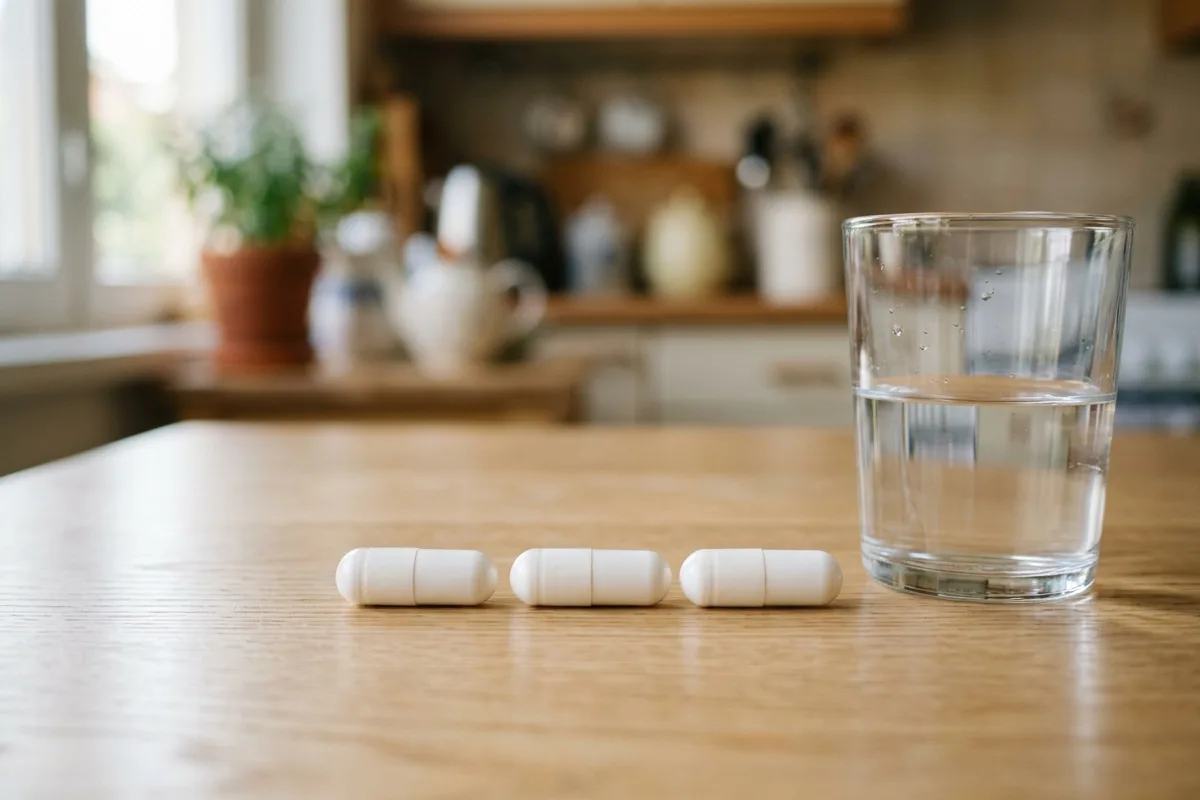
This is the step most shoppers skip. The amounts in the Supplement Facts panel are per serving, and one serving is often more than one capsule.
The FDA's labeling guide says "One serving of a dietary supplement equals the maximum amount recommended, as appropriate, on the label." Companies may add a "per unit" column, but the "per serving" column is the required one (FDA Labeling Guide, Chapter IV, Q4 and Q19).
Here is the math with a made-up label:
| Line on the label | What it says | What it means |
|---|---|---|
| Serving size | 3 capsules | All numbers below need 3 capsules |
| Servings per container | 30 | 90 capsules last 30 days at 3 a day |
| Glucosamine sulfate | 1,500 mg | 500 mg per capsule |
If you take one capsule a day to "make the bottle last," you get 500 mg. That's one-third of the 1,500 mg used in the Reginster trial.
Run the check the other way, too. A label with "Serving size: 1 capsule" and "Glucosamine 1,500 mg" is possible, but expect a large capsule. If the serving is 1 small capsule, the amount inside will be small too. There's only so much room in a pill.
Quick formula: amount per serving ÷ capsules per serving = amount per capsule. Then compare the per-serving amount with the study dose.
Proprietary blends: what the total weight can and can't tell you
A proprietary blend is a group of ingredients listed under one name, with one total weight. The FDA requires the words "Proprietary Blend," the total weight of the blend's ingredients on the same line, and the ingredients listed "in descending order of predominance by weight" (FDA Labeling Guide, Q34).
What the label doesn't have to tell you is how much of each ingredient is inside.
The order still gives you a ceiling. If ingredients are listed from heaviest to lightest, the second one can be at most half the total. The third can be at most one-third. The tenth can be at most one-tenth.
Example: a "Joint Complex" blend of 900 mg lists glucosamine third. Glucosamine can be no more than 300 mg per serving. The studies above used 1,500 mg. The math rules out the studied dose before you even ask the company.
The same trick works for boswellia, MSM or turmeric sitting low in a long blend. When the ceiling is far below the study dose, you have your answer.
What to look for: individual amounts for each key ingredient. A blend isn't a lie, but it keeps you from checking.
Why "% Daily Value" is blank on joint ingredients
The % Daily Value (DV) column compares an amount with a daily reference, like vitamin C or calcium. Many joint ingredients have no such reference.
For those, the FDA requires a symbol in the % Daily Value column that points to the footnote "Daily Value Not Established." The company must still list "the quantitative amount by weight per serving" (FDA Labeling Guide, Q9 and Q30).
So the asterisk or dagger next to glucosamine, MSM or boswellia is normal. It doesn't mean the amount is low or high. It means the label gives you no yardstick, and the study dose has to be your yardstick.
If a joint formula also includes vitamin C, vitamin D or manganese, those lines will show a percentage. Add them up across every supplement you take each day, and ask your pharmacist if any nutrient lands well above 100%.
Turmeric vs. curcumin on the label: standardization, piperine and a liver warning
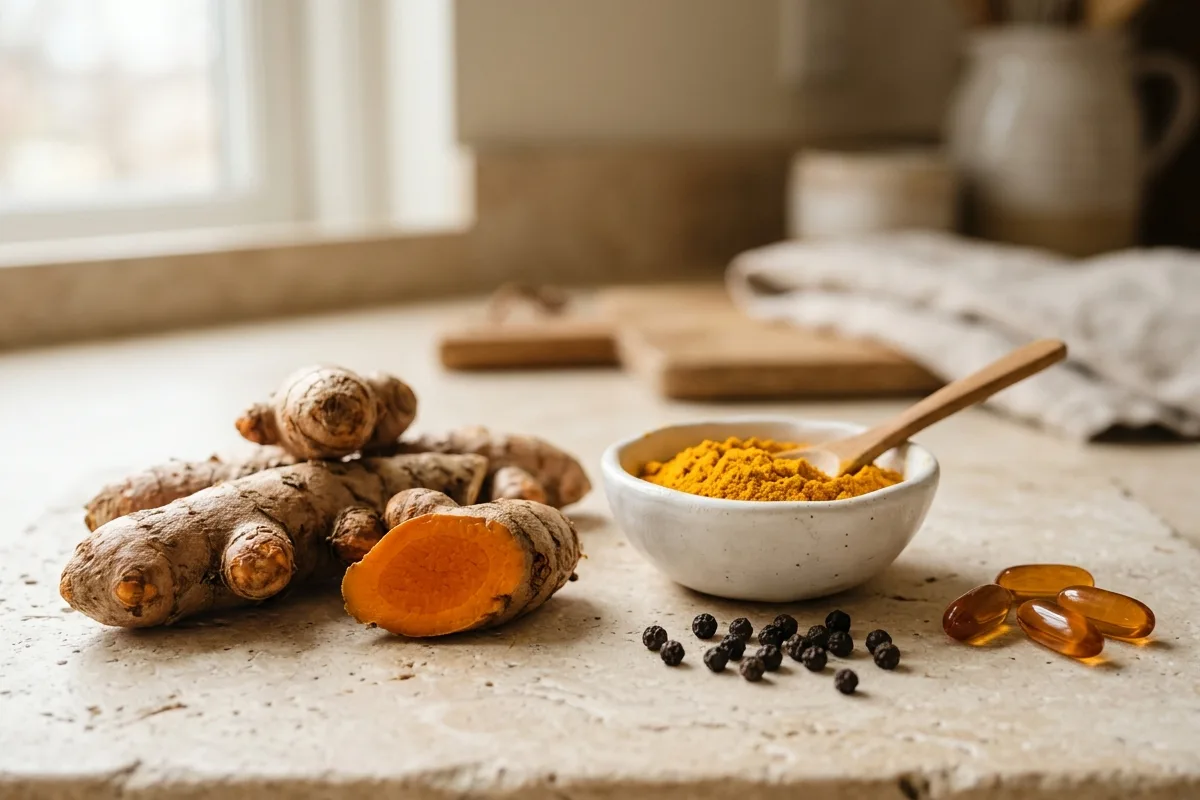
"Turmeric" and "curcumin" are not the same line on a label. Turmeric is the root. Curcumin is one of the compounds in it. A label that says "turmeric root powder 500 mg" tells you the weight of the root, not of the curcumin.
That matters because the trials measure curcumin. A meta-analysis of 8 randomized trials concluded that turmeric extract at "about 1000 mg/day of curcumin" eased arthritis symptoms. The same authors wrote that the number and quality of trials "were not sufficient to draw definitive conclusions," and the first author works for a supplement manufacturer (Daily 2016, J Med Food).
What to look for: an extract with a stated standardization, such as "standardized to X% curcuminoids," so you can work out the curcumin amount. Without a percentage, you can't compare it with the study dose.
Many formulas add black pepper extract (piperine). NCCIH confirms that "Combining curcumin with piperine is one way to improve the bioavailability of curcumin." Bioavailability means how much your body actually absorbs.
Better absorption has a flip side. NCCIH warns that "Highly bioavailable formulations of curcumin... may harm your liver." It lists the signs: fatigue, nausea, poor appetite, dark urine or jaundice (yellow skin or eyes). If any of them show up, NCCIH advises stopping the product right away and contacting your health care provider (NCCIH, Turmeric).
A label that says "with piperine" or "enhanced absorption" is not a red flag in itself. It is a reason to know those signs.
Collagen type II (UC-II) vs. hydrolyzed collagen: milligrams vs. grams
Two very different things are both called "collagen" on joint labels.
Undenatured type II collagen (UC-II is one branded form) is collagen that has not been broken down. It is used in tiny amounts. In a 180-day trial of 191 people with knee osteoarthritis, the dose was 40 mg a day. The authors reported better knee symptom scores than placebo and than the glucosamine-chondroitin group, and good tolerance (Lugo 2016, Nutr J). All but one listed author worked for the company that makes the ingredient, so read it with that in mind.
Hydrolyzed collagen (often called collagen peptides) is collagen broken into small pieces. It's a different ingredient, usually sold by the scoop. We didn't review a knee trial for it for this guide, so we don't give a dose here.
The label trap: "Collagen 40 mg" and "Collagen 10 g" can both look reasonable. One is 250 times the other. Check three things:
- the type (type II, or no type at all),
- the word undenatured or hydrolyzed,
- the unit, mg or g.
A label that says only "collagen" with no type is hard to compare with any study.
Boswellia: look for the boswellic acid (AKBA) percentage
Boswellia comes from the resin of the Boswellia serrata tree. What researchers measure is a group of compounds called boswellic acids, and one in particular, AKBA.
In a 90-day trial of 75 people with knee osteoarthritis, participants took 100 mg or 250 mg a day of an extract enriched to 30% AKBA. Both groups reported better pain and function scores than placebo (Sengupta 2008, Arthritis Res Ther). The authors worked for the company that produces that extract.
The key detail is the percentage. An extract at 30% AKBA isn't the same as plain resin, even at the same 100 mg. A label that says "Boswellia serrata extract 300 mg" with no percentage gives you nothing to compare.
What to look for: the plant part (FDA requires it on the panel, per Q2 of the labeling guide), the extract amount and the boswellic acid or AKBA percentage.
MSM and hyaluronic acid: grams, milligrams and few trials
MSM (methylsulfonylmethane) shows up in many formulas. The pilot trial we found used 3 g twice a day (6 g a day) for 12 weeks in 50 adults. The authors wrote that benefits and long-term safety "cannot be confirmed from this pilot trial" (Kim 2006, Osteoarthritis Cartilage).
Most capsules hold well under a gram. So 500 mg of MSM in a multi-ingredient formula is a small fraction of 6 g. That isn't a safety problem. It's a mismatch with the only study dose we could check.
Hyaluronic acid also appears on many labels. We didn't find an oral trial dose we could verify for this guide, so we leave the number out rather than guess.
"Supports joint comfort" vs. disease claims: reading the FDA disclaimer
Phrases like "supports joint comfort" or "helps maintain healthy cartilage" are structure/function claims. Supplements may use them. The FDA says these claims are "not pre-approved by FDA." The company must have evidence the claim is truthful and must notify the FDA "no later than 30 days after marketing the dietary supplement" (FDA, Structure/Function Claims).
When a label carries such a claim, it must also carry a disclaimer. It says the FDA has not evaluated the statement and that the product is not intended for any disease. The FDA page linked above has the exact wording.
The FDA is also clear on the bigger picture: "Under DSHEA, FDA does not have the authority to approve dietary supplements before they are marketed" (FDA Q&A). DSHEA is the 1994 law that governs supplements.
How to read it in practice:
- "Supports," "maintains," "promotes" are normal supplement language.
- A named disease (arthritis, osteoarthritis) plus a promise to treat or prevent it is a disease claim. Supplements aren't allowed to make those.
- A missing disclaimer next to a structure/function claim is a labeling problem.
- "FDA approved" on a supplement is a red flag. The FDA doesn't approve supplements before they're sold.
USP, NSF and "GMP" seals: what each one actually checks
Seals answer one question: is what's in the bottle what the label says? They don't tell you whether the product works for your knees.
NCCIH suggests looking for products tested by "independent, third-party groups such as nonprofit U.S. Pharmacopoeia (USP) Dietary Supplement Verification Program" and names ConsumerLab.com as another. That testing helps confirm a supplement "contains what's on the label" (NCCIH, tips on reading supplement labels).
The Russell lab test above shows why that matters. Labels and contents can drift far apart.
NSF also runs a supplement certification program. We tried to pull up the official USP and NSF pages to quote exactly what each seal covers, but neither would load for us. So we won't describe their test lists from memory. If a product shows either seal, look the product up in that organization's own online listing.
"Made in a GMP facility" is a different thing. GMP (good manufacturing practice) is the federal rule every supplement maker must follow, published by the FDA as 21 CFR Part 111 (Federal Register, June 25, 2007). It is the legal floor, not an extra test. A "GMP" badge with no organization's name tells you little.
Expiration date and lot number: what they prove and what they don't
Lot number. Federal rules require manufacturers to assign "a batch, lot, or control number" to each lot of packaged and labeled supplement (21 CFR 111.415(f)). The maker must also be able to trace each product's complete manufacturing history through distribution (21 CFR 111.410(d)).
A lot number printed on your bottle is how you connect it to that record. If you have a reaction or a complaint, it is the number the company and your doctor will want. Take a photo of it before you toss the bottle.
Expiration date. Here the honest answer is narrower than many guides suggest. When the FDA wrote the supplement manufacturing rule in 2007, it chose "not to require that you establish an expiration date for your product." It added that "Any shelf life date that you include on the label of the product should be supported by data" (Federal Register 2007, section X.K, Comments on Shelf Life).
So a bottle without an expiration date is not automatically breaking federal rules. A bottle with one should have stability data behind it. State rules may differ, and we have not checked any. If the date has already passed, skip that bottle.

Who should not take it, and talk to your doctor if...
The panel and the warning box are where safety information lives. Read them, and if you take any medicine, ask your doctor first. The FDA advises people to "talk to their doctor, pharmacist, or other health care professional" before using a supplement (FDA Q&A).
Talk to your doctor before a joint supplement if:
- You take a blood thinner. NCCIH says glucosamine and chondroitin "have been associated with an increased risk of bleeding in people who are taking the anticoagulant warfarin" (NCCIH).
- You have diabetes or watch your blood sugar. Glucosamine "may cause increases in blood glucose (sugar) levels in some people," per the same NCCIH page.
- You have a shellfish or other food allergy. Read the source line and any "Contains" statement. We did not find an official U.S. source that settles the glucosamine and shellfish question, so bring the label to your doctor.
- You are pregnant or breastfeeding. "Little is known" about glucosamine and chondroitin safety then, per NCCIH. For turmeric, NCCIH says supplements during pregnancy "may be unsafe" (NCCIH, Turmeric).
- You have liver problems, or notice the warning signs listed in the turmeric section.
- You have surgery scheduled. The FDA notes that your health care professional "may ask you to stop taking dietary supplements two or three weeks before the procedure" (FDA consumer update).
Bring the bottle, or a photo of the Supplement Facts panel, to the appointment. It saves guessing.

Common mistakes
- Reading only the front. The real numbers are on the Supplement Facts panel.
- Taking fewer capsules than one serving. The amounts on the panel assume the full serving.
- Comparing sulfate and HCl milligrams as if they were equal. The free base differs.
- Trusting a big blend total. Order by weight limits what each ingredient can be.
- Reading "turmeric" as "curcumin." Look for the standardization percentage.
- Mixing up mg and g on collagen. Type II and hydrolyzed collagen are different ingredients.
- Reading any seal as proof it works. A seal checks contents, not results.
Key takeaways
- The Supplement Facts panel, not the front of the box, is where the answers are.
- Amounts are per serving, and one serving can be 2, 3 or more capsules.
- For joint ingredients, the study dose is the only yardstick, because there is no Daily Value.
- Studied doses we checked: glucosamine sulfate 1,500 mg, curcumin about 1,000 mg, UC-II 40 mg, boswellia extract 100 to 250 mg at 30% AKBA, MSM 6 g.
- Blends list ingredients by weight, which sets a ceiling you can calculate.
- Every lot must get a lot number. The FDA doesn't require an expiration date, but any date that's printed should be backed by data.
- If you take a blood thinner, manage blood sugar, are pregnant or have surgery coming, ask your doctor first.
Read next
- How we research and write our guides: our rules for sources, doses and corrections.
- About MobilityGauge: who we are, and why none of us gives medical advice.
Sources
- FDA. Dietary Supplement Labeling Guide, Chapter IV: Nutrition Labeling (Q2, Q4, Q9, Q19, Q30, Q34).
- FDA. Structure/Function Claims. Content current as of 03/28/2024.
- FDA. Questions and Answers on Dietary Supplements. Updated 08/27/2026.
- FDA. Mixing Medications and Dietary Supplements Can Endanger Your Health. Content current as of 06/02/2022.
- FDA. Current Good Manufacturing Practice for Dietary Supplements, final rule. Federal Register 72(121), June 25, 2007, section X.K.
- 21 CFR 111.410 and 111.415, via Cornell Legal Information Institute.
- NCCIH. Glucosamine and Chondroitin for Osteoarthritis. October 2023.
- NCCIH. Turmeric. April 2025.
- NCCIH. Tips on Reading Supplement Labels.
- Russell AS et al. Active ingredient consistency of commercially available glucosamine sulfate products. J Rheumatol. 2002.
- Reginster JY et al. Long-term effects of glucosamine sulphate on osteoarthritis progression. Lancet. 2001.
- Clegg DO et al. Glucosamine, chondroitin sulfate, and the two in combination for painful knee osteoarthritis. N Engl J Med. 2006.
- Lugo JP et al. Efficacy and tolerability of an undenatured type II collagen supplement in modulating knee osteoarthritis symptoms. Nutr J. 2016.
- Sengupta K et al. A double blind, randomized, placebo controlled study of 5-Loxin in osteoarthritis of the knee. Arthritis Res Ther. 2008.
- Daily JW et al. Efficacy of turmeric extracts and curcumin for alleviating the symptoms of joint arthritis. J Med Food. 2016.
- Kim LS et al. Efficacy of methylsulfonylmethane (MSM) in osteoarthritis pain of the knee: a pilot clinical trial. Osteoarthritis Cartilage. 2006.
Frequently asked questions
How do I read a supplement label for joint health?
Go to the Supplement Facts panel. Check the serving size, the form of each ingredient, whether amounts sit inside a proprietary blend, and how each amount compares with the dose used in published trials. Then read the warnings and find the lot number.
What does "per serving" mean on a joint supplement?
It means the amounts listed assume you take the full serving, which the FDA defines as the maximum amount recommended on the label. If the serving is 3 capsules, one capsule gives you a third of each number.
Is glucosamine sulfate better than glucosamine HCl?
The 3-year glucosamine trial cited here used glucosamine sulfate at 1,500 mg a day, and a later trial used the HCl form as a comparison group. NCCIH says it is still uncertain whether glucosamine and chondroitin help knee osteoarthritis symptoms. What you can control is knowing which form you are buying.
What is a proprietary blend, and is it bad?
It is a group of ingredients listed with one total weight and no individual amounts. It is legal, but you can't check doses. Because ingredients are listed from heaviest to lightest, you can still calculate the most each one could be.
Why does my joint supplement have no % Daily Value?
Most joint ingredients have no Daily Value. The FDA requires a symbol pointing to "Daily Value Not Established" and the amount by weight. Use the study dose as your comparison instead.
How much UC-II was used in the knee study?
The 180-day knee trial cited here used 40 mg a day of undenatured type II collagen. That is a very different amount from hydrolyzed collagen, which is sold in grams. Check the type and the unit on the label.
Do USP or NSF seals mean a supplement works?
No. Third-party testing helps confirm a product contains what the label says, according to NCCIH. It says nothing about whether the product will help your joints.
Do supplements have to have an expiration date?
Not under federal rules. In its 2007 manufacturing rule, the FDA chose not to require an expiration date. If a date is printed, the FDA says it should be supported by data. A lot number, by contrast, must be assigned to every lot.
Next step
Take one joint supplement you own, or one you are considering, and run the five checks from the quick answer: form, serving, blend, study dose and lot number. Write down what you find. If you take any medicine, ask your doctor first, and bring that note and the bottle with you.